
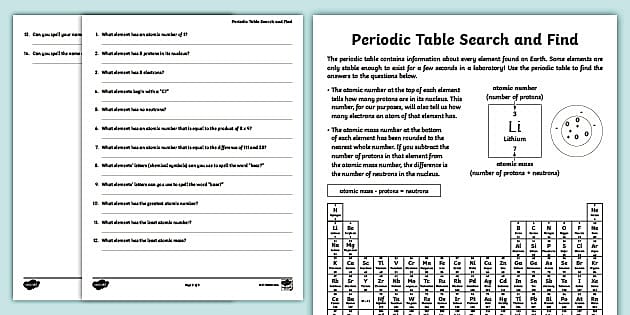
In the realm of chemistry education, the periodic trends worksheet serves as an invaluable tool for students and educators alike. This document provides a structured approach to exploring the periodic table and its underlying principles, helping learners grasp the intricate relationships between various chemical elements. Understanding periodic trends is fundamental in predicting the behavior and properties of elements, making this worksheet an essential component of any chemistry curriculum.
The periodic trends worksheet delves into the patterns and changes in properties of elements across the periodic table. It covers key concepts such as atomic radius, ionization energy, electron affinity, and electronegativity—crucial factors that define how elements interact and form compounds. Let’s explore how this worksheet is utilized in the study of chemistry and how it aids in deepening our comprehension of the chemical world.
Exploring Atomic Radius and Its Significance
One of the fundamental aspects covered in the periodic trends worksheet is atomic radius—the distance from the nucleus of an atom to its outermost electrons. This concept plays a pivotal role in understanding the periodic table’s structure and the trends that emerge within it. As students work through the worksheet, they compare the atomic radii of elements across periods and down groups, observing predictable patterns.
For instance, within a period (a row of the periodic table), atomic radius generally decreases from left to right. This trend can be attributed to increasing nuclear charge, which attracts electrons more strongly, thus reducing the atomic size. Conversely, down a group (a column of the periodic table), atomic radius increases due to the addition of energy levels (shells) around the nucleus. By engaging with these trends through the worksheet, students develop a clearer picture of how atomic structure influences elemental behavior.
Ionization Energy and Electron Affinity
Ionization energy—the energy required to remove an electron from an atom—and electron affinity—the energy change that occurs when an electron is added to an atom—are also vital topics addressed in the periodic trends worksheet. These properties are crucial in predicting an element’s reactivity and ability to form ions.
As students progress through the worksheet, they discover that ionization energy generally increases across a period and decreases down a group. This trend is due to similar factors affecting atomic radius—namely, nuclear charge and electron shielding. Electron affinity, on the other hand, tends to increase across a period and decrease down a group. These trends can be explained by variations in atomic structure and the desire of atoms to attain a stable electron configuration.
Understanding Electronegativity
Electronegativity—a measure of an atom’s ability to attract shared electrons in a chemical bond—is another concept explored within the periodic trends worksheet. It provides insights into the nature of chemical bonding and the polarity of molecules. Similar to other trends, electronegativity values generally increase across a period and decrease down a group.
By engaging with these concepts through the periodic trends worksheet, students gain a deeper understanding of why certain elements exhibit specific behaviors and properties. They learn to apply these trends to practical scenarios, predicting chemical reactions and explaining phenomena observed in the laboratory.
Application of Periodic Trends Worksheet in Education
The periodic trends worksheet serves as a bridge between theoretical knowledge and real-world applications. Educators leverage this tool to reinforce classroom learning and encourage critical thinking. Students are tasked with analyzing data, drawing conclusions, and making connections between different elements based on their positions in the periodic table.
Furthermore, the worksheet encourages interactive learning through exercises that prompt students to interpret graphs, solve problems, and engage in discussions. By actively participating in these activities, learners develop problem-solving skills and a deeper appreciation for the systematic nature of chemistry.
Enhancing Chemistry Curriculum with Periodic Trends Worksheet
Integrating the periodic trends worksheet into the chemistry curriculum enhances the overall learning experience. It provides a structured framework for exploring the periodic table, enabling students to recognize patterns and draw correlations between various properties of elements. This approach fosters curiosity and empowers students to explore the fascinating world of chemistry with confidence.
In conclusion, the periodic trends worksheet is a powerful educational tool that facilitates the exploration of elemental properties and their relationships within the periodic table. By incorporating this worksheet into chemistry education, students gain a comprehensive understanding of atomic structure, bonding, and reactivity. It cultivates critical thinking skills and prepares learners for future studies and careers in the field of chemistry. As we continue to refine our teaching methodologies, the periodic trends worksheet remains an essential resource for unlocking the mysteries of the chemical world.